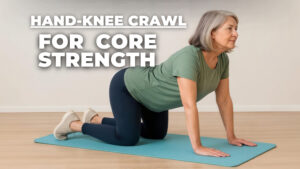
Hand-Knee crawl for core strength
Why Crawling is Worth Trying At Any Age (Especially After 50)
Crawling isn’t just for babies. It’s a full-body movement that can help you get stronger, more mobile, and more balanced – without needing fancy equipment or a gym membership. In this video (https://youtu.be/Kwj56U0KXGU), I call crawling one of the most underrated exercises, and I’d like to show you why. 

What Crawling Does for Your Body

  1. Strengthens Your Core and Shoulders
Crawling uses your deep core muscles, shoulders, and hips all at once. Research shows that crawling can target your abs, obliques, and back muscles while keeping your spine supported  - this video shows you how to do it in a “bear crawl” (https://www.self.com/story/bear-crawl-exercise)).
  1. Keeps Your Joints Moving
Shoulders, wrists, hips, and ankles all get gentle movement, which is important as wrist fractures are common in women as they age.  The novel movement that your joints go through  can help with stiffness and keep your joints lubricated through a range of motion they are not used to. (https://betterme.world/articles/crawling-exercises-boost-core-and-mobility)). 3. Improves Balance and Coordination Crawling uses an opposite hand–opposite foot pattern. This cross-body action wakes up your brain and helps with coordination – an important skill to maintain as we age. If you think about it is one of the methods that toddlers use to help develop their brains, they crawl! (https://wholelifehealth.uk/post/benefits-of-crawling-movement)). 4. Builds Real-World Strength The strength you gain from crawling makes everyday tasks easier – carrying groceries, bending to pick something up and especially getting up from the floor.  As we age these movements become harder to do, reaching under a kitchen table to pick something up etc…they should be easy but if we lack the strength and flexibility to get down to the floor efficiently they can become challenging. 
How to Start Crawling
You don’t need much space – a yoga mat or a bit of carpet is enough. Step 1: Set Up Start on all fours with your hands under your shoulders and your knees under your hips. Tuck your toes under. Step 2: Lift Your Knees Lift your knees just an inch or two off the ground. Keep your back flat and your tummy gently pulled in. Step 3: Move Slowly Move your right hand and left foot forward together, then your left hand and right foot. Take small, slow steps with your feet so they don’t ‘catch up’ with your hands and you end up sticking your butt in the air. Step 4: Start Small Try 15–20 seconds at a time. Rest, then repeat for two or three rounds. As you get comfortable, add a little more time or try crawling backward or sideways.
Tips for People Over 50
  • Keep your movements slow and controlled.
  • If your wrists feel uncomfortable, you can follow some wrist mobilization before hand - like this one: https://youtu.be/LQXOscoE2jc?si=mM05ZBCeIncI3aad
  • Focus on quality over quantity – a few good steps are better than rushing.
  • Pair it with your regular walks or strength routine for a whole-body boost.
Why It’s Worth Adding to Your Routine
Crawling brings together strength, mobility, and brain-body coordination in one simple move. It’s easy to fit into your day, gentle enough to start with, and can grow with you as you get stronger. A few minutes a day is enough to make a difference in how steady, strong, and mobile you feel.  
Moving Forward – Staying Active with Scoliosis
Moving Forward – Staying Active with Scoliosis By Ed Paget, Osteopath & Creator of the Scoliosis Correction Protocol If you have scoliosis and you’re unsure how to move without making things worse, you’re not alone. A lot of people I speak with have either been told to avoid exercise altogether or they’ve tried things that didn’t help—or made their pain worse. The truth is, movement can help, but it needs to be the right kind of movement. That’s what inspired me to create the Scoliosis Correction Protocol—a program built on years of clinical experience, focused on mobility, strength, and endurance tailored to your spine. Here’s what I want you to know about exercising with scoliosis.
1. Start with Low-Impact, Spine-Friendly Movement

If you’re just getting started or coming back from a break, don’t jump into high-intensity training. Walking, swimming, and cycling are good choices. They get your muscles working without compressing the spine. Swimming stands out because water reduces pressure on the joints while giving you full freedom to move. You don’t need to swim laps for an hour—a short 15–20 minute swim a few times a week is a solid start.

2. Build Core Stability Without Crunches

You need core strength, but not from crunches or sit-ups. Those often overload the spine. Instead, focus on controlled movements that stabilize the deep abdominal and spinal muscles. Start with: These help reduce pain, improve alignment, and give your spine more support. For those of you looking for something more functional I would suggest a wood chop type movement, and you get bonus points if you can do it in a direction that will help decrease the rotation often associated with scoliosis. 

3. Make Stretching a Daily Habit

Tight hips, shoulders, or hamstrings can increase the work load to your spine. Stretching those areas daily makes a big difference. Use gentle, scoliosis-aware stretches like: These don’t fix the curve, but they help reduce pressure and increase comfort.  

4. Pay Attention to Your Feet

Poor foot mechanics can pull everything above them out of place. If one leg feels shorter, or if your feet roll in or out when you walk, that can aggravate scoliosis. Use supportive shoes and talk to a physical therapist or biomechanical specialist if you think orthotics might help. Small changes here can improve how your whole body moves. One exercise I really like is called the “Foot Core” exercise and it actually helps strengthen your feet - try it: Foot Core Exercise

5. Don’t Push Through Pain

Discomfort during a workout is one thing. Sharp, stabbing, or lingering pain is another. Learn to tell the difference. If something doesn’t feel right, adjust your intensity, change the movement, or stop and switch to something gentler. More is not always better. Listening to your body keeps you in the game long-term.  

6. Rotate Your Activities

If you repeat the same motion over and over—especially with scoliosis—you’ll reinforce your asymmetries. Cross-training helps by working different muscle groups and avoiding overload. Try mixing: It keeps your body balanced and your routine interesting.

7. Focus on Consistency, Not Perfection

Your goal isn’t perfect posture or a completely straight spine. It’s control, strength, and confidence. You don’t need to train every day. Two or three focused sessions per week can lead to lasting change if they’re done right. What matters most is staying consistent and adjusting your routine based on how you feel. You can live well with scoliosis. You can move with less pain. You can build a stronger, more balanced body. These aren’t just ideas—they’re the foundation of the Scoliosis Correction Protocol. It's designed to meet you where you are and grow with you. If you’re ready to take a more targeted approach to exercise, you can book a call with me or one of my team and together we’ll figure out the best next step for you. https://scoliosiscorrectionprotocol.com/one-on-one-training527366      
What Happens to Your Body When You Stop Breathing at Night
Have you ever woken up feeling exhausted despite clocking in a full eight hours of sleep? If so, you might be experiencing a condition called sleep apnea. This isn’t just about feeling tired; it’s about your body literally stopping breathing multiple times each night, causing severe damage to vital organs and leaving you drained during the day. In this article, we’ll dive deep into what sleep apnea really is, why it’s so dangerous, and explore natural, non-invasive solutions to help reclaim your restful nights.

Understanding Sleep Apnea: The Silent Nighttime Threat

Sleep apnea is a disorder where your breathing repeatedly stops and starts during sleep. Imagine suffocating multiple times in the night at a time when your body should be resting and repairing itself. This lack of oxygen and disrupted sleep prevent your body from healing, leading to damage across your cardiovascular system, brain, and overall health. It’s a “double whammy” — you lose restorative rest and simultaneously inflict harm on your body. There are two main diagnostic thresholds used for sleep apnea:
  • The American Academy of Sleep Medicine defines sleep apnea as having more than five breathing interruptions (events) per hour.
  • The Centers for Medicare & Medicaid Services (CMS) considers 15 or more events per hour as the cutoff, often classifying 5-15 events as mild sleep apnea.
Regardless of the number, sleep apnea is a serious health concern, especially because many people live with it undiagnosed or untreated.

Why Sleep Apnea Is More Common and Lethal Than You Think

Contrary to popular belief, sleep apnea doesn’t only affect overweight individuals. In fact, about 10% of the general population has sleep apnea, while around 60% have anatomical features like a narrow airway that could predispose them to it. Many young, fit people also suffer from it, often unaware. Sleep apnea is a life-threatening condition. People over 40 with sleep apnea can face a reduction in life expectancy by 10 to 25 years. It is a gateway disease that increases the risk of heart attacks, strokes, diabetes, and even sudden death at night. For example, statistics show that between five and ten people suffocate overnight each day due to sleep apnea, often found "dead in bed.” Additionally, sleep apnea dramatically raises the risk of hospitalization from illnesses like the flu by up to five times, highlighting how it compromises your body’s ability to cope with stressors.

The Conventional Approach: CPAP Machines and Their Limitations

The Continuous Positive Airway Pressure (CPAP) machine is the standard medical treatment for sleep apnea. This device delivers a steady stream of air through a mask, keeping your airway open while you sleep. However, CPAP therapy has significant drawbacks:
  • Many people find the CPAP uncomfortable, anxiety-provoking, and difficult to tolerate. Imagine having a plastic leaf blower strapped to your face all night — it’s no wonder compliance rates are low.
  • Studies show that only about 30-40% of people prescribed CPAP machines use them consistently over the long term. The majority end up abandoning the device, often leaving it unused under their bed.
  • Insurance companies monitor CPAP usage closely. Failure to meet usage requirements can result in loss of coverage or higher premiums, adding financial and psychological pressure.
While CPAP is a lifesaving tool for some, many patients seek alternatives that are less invasive and more manageable.

A Personal Journey to a Natural Solution

Dr. Dylan Pis, a medical doctor and researcher, found himself struggling with sleep apnea despite being young and relatively fit. After a sleep study confirmed moderate sleep apnea, he tried CPAP but quickly rejected it due to discomfort. His journey to find a better solution led him deep into the science of sleep apnea and breathing. What he discovered challenged conventional wisdom. Sleep apnea isn’t just about a narrow airway blocking airflow; it’s also about how we breathe. Studies dating back to 1953 showed that hyperventilation — breathing too fast and too deeply — can actually trigger sleep apnea episodes. This creates a vicious cycle of overbreathing followed by cessation of breath, then overbreathing again. This cycle causes negative pressure in the airway that pulls the tongue and throat tissues inward, blocking airflow. So, sleep apnea arises from a combination of anatomical factors and dysfunctional breathing patterns.

Breathing Patterns and Sleep Apnea: The Missing Link

Dr. Pis explains that about 60% of people have anatomical features that might narrow their airways, but only 10% develop sleep apnea. The difference is often in the breathing pattern. Poor breathing habits, especially rapid, shallow breathing, exacerbate airway collapse during sleep. By focusing on improving breathing patterns, Dr. Pis developed natural, non-invasive methods to reduce sleep apnea symptoms without surgery or CPAP machines. His approach includes simple breathing exercises, myofunctional therapy (exercises to strengthen tongue and throat muscles), and lifestyle changes targeting mitochondrial health.

Simple Breathing Exercises That Make a Difference

The first step involves practicing slow, controlled breathing with prolonged exhalations. For example, inhaling slowly to half your normal breath volume, then exhaling as slowly as possible through the nose. Doing this before sleep can reduce the drive to overbreathe at night. This technique helps your body retain more carbon dioxide (CO2), which is crucial because CO2 is the primary chemical signal that regulates breathing. People with sleep apnea often have an abnormal response to CO2, leading their brains to overreact and cause hyperventilation.

Testing Your Breathing: The Relaxed Breath Hold

One practical way to assess your breathing control is the Relaxed Breath Hold Test. Here’s how to do it:
  1. Take a normal breath in through your nose.
  2. Exhale slowly and fully through your nose.
  3. Hold your breath after exhaling, staying relaxed and breathing again at the first sign of air hunger (a slight tug or warm sensation in your chest).
Most people with sleep apnea will hold their breath comfortably for less than 15 seconds. As you improve your breathing, this time can increase dramatically — reaching 30 seconds or more often signifies substantial progress.

Beyond Breathing: Strengthening Your Airway and Optimizing Lifestyle

Breathing exercises alone can improve symptoms by about 40%, but Dr. Pis emphasizes a holistic approach to sleep apnea:

Myofunctional Therapy

This involves targeted exercises to strengthen the muscles of the tongue, lips, and throat. Stronger muscles help keep the airway open naturally during sleep, reducing collapses and interruptions.

Mitochondrial Health and Metabolic Support

Sleep apnea also involves issues with how your body produces and uses CO2, linked to mitochondrial function — the powerhouse of your cells. Improving your nutrition, managing stress, optimizing your circadian rhythm, and supporting your nervous system all play roles in enhancing mitochondrial health and reducing sleep apnea severity.

Common Myths: Why Mouth Tape Isn’t a Cure-All

Mouth tape, which encourages nasal breathing by keeping the mouth closed during sleep, has gained popularity. However, Dr. Pis clarifies that mouth breathing is a symptom, not the root cause, of poor breathing patterns. While mouth tape may help some people with mild sleep apnea, it generally only reduces severity slightly and is not a standalone solution for moderate to severe cases. The focus should be on correcting the underlying breathing dysfunction rather than forcing the mouth closed.

How to Know if You Might Have Sleep Apnea: The STOP-BANG Questionnaire

If you suspect sleep apnea, you can start with a simple screening tool called the STOP-BANG questionnaire, which asks eight yes/no questions:
  • Do you snore loudly (loud enough to be heard through closed doors)?
  • Do you often feel tired, fatigued, or sleepy during the daytime?
  • Has anyone observed you stop breathing during sleep?
  • Do you have or are you being treated for high blood pressure?
  • Is your BMI greater than 35 or are you more than 30 pounds overweight?
  • Are you over 50 years old?
  • Is your neck circumference greater than 40 cm (about 15.7 inches)?
  • Are you male?
A score of three or more indicates moderate risk, and five or above suggests a high likelihood of sleep apnea, warranting a formal sleep study.
Nature or Nurture – How Important Are Genes On Longevity Anyway?
A groundbreaking study recently published in the journal Nature Medicine offers a fascinating deep dive into how much our environment and genetics contribute to our health, aging, and longevity (1). Researchers analyzed a wealth of data from nearly 500,000 participants in the UK Biobank, focusing on three key questions:
  1. Which environmental factors are most predictive of aging and premature death?
  2. How do these factors impact biological aging, disease risks, and common aging biomarkers like cholesterol and inflammation?
  3. How do environmental influences (the exposome) compare to genetic factors (the genome) in determining our risk of mortality and age-related diseases?
The Key Role of Lifestyle and Environmental Factors The study began by looking at 164 lifestyle and environmental factors—everything from smoking and physical activity to sleep patterns, diet, socioeconomic status, and early-life conditions. After thorough testing and replication, 25 factors emerged as consistently linked to early mortality. Interestingly, these factors didn’t just impact the likelihood of dying early—they also influenced proteomic aging, which estimates a person’s biological age. To do this they used a genetic clock, similar to the one that Dr Morgan Levine discussed in my podcast, Your Lifestyle Is Your Medicine, back in Episode 6.  What they found was that if an environmental factor predicted a higher risk of mortality, it was also associated with accelerated aging.  What Are The Key Factors Associated With Aging and Mortality? - Smoking status: and lifetime exposure to smoking, including prenatal exposure. - Physical activity, especially gym attendance - Sleep habits, like the frequency of naps or sleeping fewer than 7 hours or more than 9 hours per night - Mood, including frequent feelings of being "fed up". - Socioeconomic factors, such as income, education, and employment status. - Childhood growth patterns, including body size and height at age 10. - Ethnicity, with differences observed between White, Black, Asian, and mixed populations. How the Environment Affects Disease and Health The study also revealed that environmental and lifestyle factors influence multiple biological systems in consistent patterns. For instance, beneficial exposures like higher socioeconomic status, regular physical activity, stable employment, and healthy sleep habits were associated with healthier biomarkers, such as: - Better cholesterol profiles - Lower inflammation - Improved glucose metabolism - Healthier kidney and liver function - Longer telomeres (which indicate slower cellular aging) - Better vitamin D status On the flip side, harmful exposures like smoking, negative mood states, disrupted sleep, and socioeconomic deprivation consistently led to poorer health markers, including higher inflammation, poor lipid profiles, and accelerated cellular aging. Perhaps most striking was the consistency of these patterns across various biomarkers—whether it was metabolism, inflammation, organ function, or cellular aging. These findings point to the profound impact of environmental and lifestyle factors on our biology, offering clear pathways linking the environment to early mortality and disease. Genes vs. Environment: Who Wins? One of the major revelations from the study was the comparison between genetics and environmental factors in predicting mortality and disease risk. While age and sex were by far the strongest predictors of mortality, yes, men get the short straw here,  both genes and the environment also played substantial roles. - Environmental factors explained 16–19% of the variation in mortality risk, beyond basic demographics (age and sex). -  Genes explained only 2–3% of the variance, Environment vs. Genetics in Age-Related Diseases What I thought was really interesting is that the contributions of genetics and environment varied significantly for different diseases: - Diseases more strongly influenced by the “environment” included lung cancer, chronic liver disease, type 2 diabetes, rheumatoid arthritis, stroke, heart disease, and chronic kidney disease—all of which are heavily shaped by lifestyle choices like diet, smoking, physical activity, and socioeconomic status - which also suggest they are modifiable.  - By contrast, diseases more strongly influenced by **genetics** included certain cancers (like breast, prostate, and ovarian cancers), Alzheimer’s disease, and macular degeneration—conditions known to have a strong hereditary component. In Dr. Morgan Levine’s genetic clock research, she gives us a fascinating look into how we might measure biological age and the impact of genetics on aging. But even she didn’t think that genes played a huge role in how well we age because it might not be possible to outlive our genetic potential. What this means for me is that even though my genetic expiry date might be less than my sisters, the environment I choose to live in might mean that I have a greater health span, mearing more healthy years of living. To me, this is arguably the goal of investing in my health now.  Not to live a super long life but to live a life that is full of energy, laughter and adventure. Let me know if you want any adjustments or additions!  
  1. https://www.nature.com/articles/s41591-024-03483-9?utm_source=brevo&utm_campaign=genes_vs_environment&utm_medium=email