
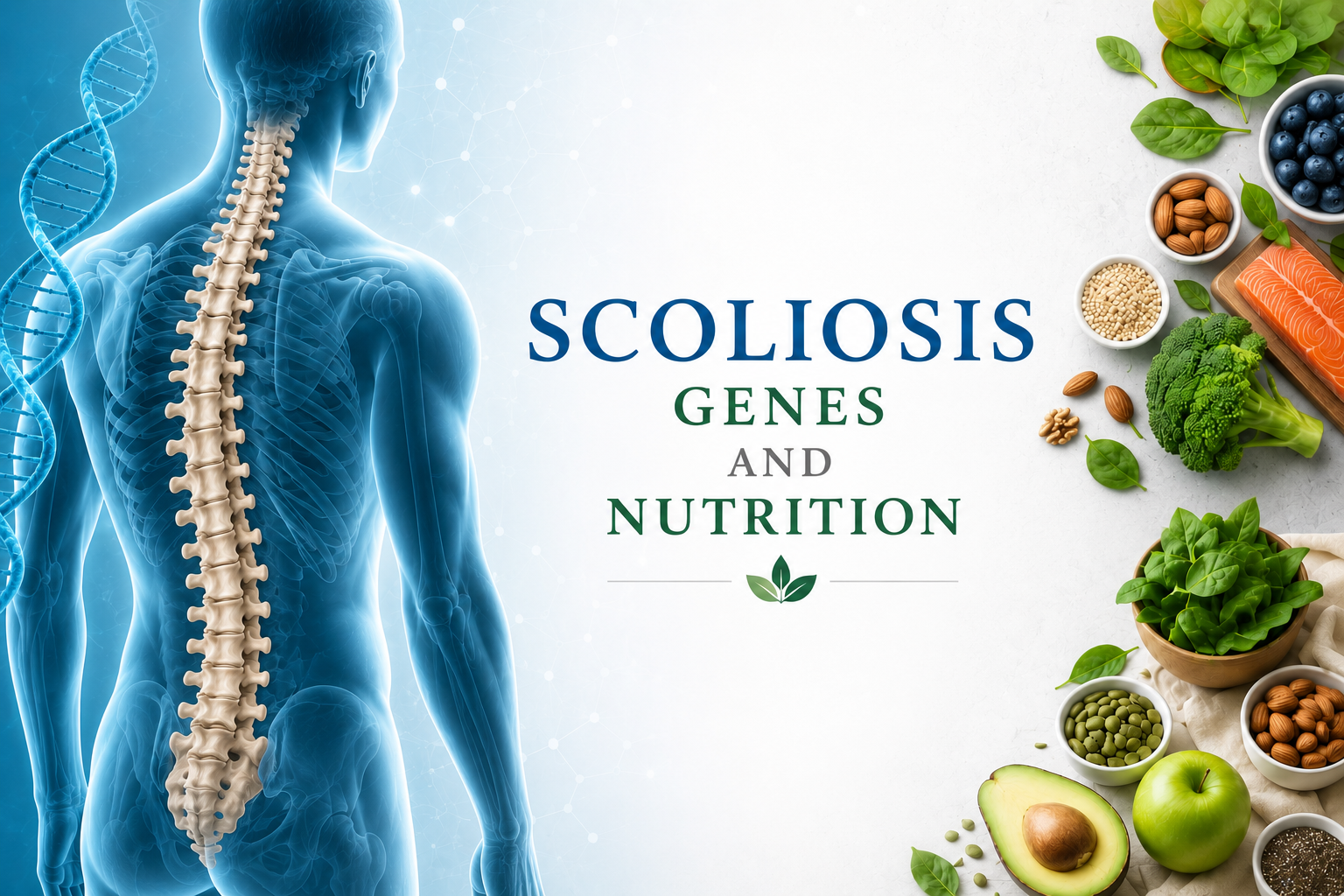
How Your Genes and Nutrition Play A Roll In Your Scoliosis
Traditional scoliosis care often traps families in a cycle of “wait and see,” watching a curve get worse while feeling powerless to stop it. For years, the industry treated Adolescent Idiopathic Scoliosis (AIS) as a simple mechanical failure—like a leaning tower that just needs a bigger brace to push it back.
The reality is that if we only look at the bones, we could be missing the “software” glitch in the brain and DNA that is driving the “hardware” collapse. New research suggests shifting from passive observation to a neuro-genomic intervention, this means we would stop treating the symptom and start addressing the body’s internal signaling.
Many teens face rapid curve progression during puberty that seems “unstoppable” even with a brace. This happens because their DNA is sending the wrong instructions to their ligaments and joints.
Researchers have begun to look at the genes for the solution. WHat they discovered is that people with scoliosis show some different gene variants when compared to people without. Two common variants are the COMT and MTHFR gene variants. A COMT variant slows down how your body clears out estrogen, which leads to “stretchy” joints (ligamentous laxity). When you combine this with an MTHFR “bottleneck” that starves the brain of nutrients, the spine loses its internal support system. Research shows that when these two variants collide, there is a greater than 20° progression in over 80% of cases.
By identifying these markers early through genomic testing, we can use targeted support like L-Methylfolate and SAMe to clear the metabolic path. The aim here is to stabilize the body’s chemistry before the growth spurt causes the curve to win. But are there other genes that could predict scoliosis progression?
If your brain has low postural memory, it essentially “forgets” where the spine is in space. This makes it hard to fix a posture that the brain doesn’t realize is crooked. I’ve heard reports of when a tether breaks in someone’s back their curve often regresses to what it was. Meaning the brain’s internal map of the spine isn’t straight.
This is often driven by a “triple-threat” of chemical imbalances: low serotonin, low histamine, and high norepinephrine. For instance, a “hyper-utilizer” MAOA variant acts like a vacuum, sucking up serotonin—the “posture manager”—before it can tell the muscles to hold the spine upright.
When we balance these chemicals (using tools like 5-HTP), we restore the brain’s “map” of the body. This may just give the nervous system the clarity it needs to maintain a straight, stable spine automatically. But how do genes play a role in things like bone building?
A spine cannot stay straight if the “bricks” used to build it are weak. Many AIS patients suffer from low bone density, making their spine “spongy” and susceptible to bending under pressure.
This isn’t just about calcium; it’s about the management of that calcium. Vitamin D acts as the delivery truck that brings calcium into the blood, but without Vitamin K2 acting as the driver, that calcium never reaches the bone matrix. It just floats around, leaving the spine weak during critical growth periods. Some studies show that up to 90% of teens with scoliosis are low in Vitamin D
Optimizing Vit D and K2 ensures that as the teen grows, they are building a high-density, resilient skeletal frame that can actually resist the mechanical pull of a curve.
Relying solely on external exercises (outside-in) often feels like fighting a losing battle against your own biology (inside-out).
Traditional Scoliosis Specific exercises are essential, but they are often performed on a body that is chemically “unbalanced.” It’s like trying to align the wheels on a car while the frame is still bent
This is where the proponents of Genomic-Informed Rehab come in. By combining neuromuscular re-education (like the Scoliosis Correction Protocol with targeted nutrition to fix the internal chemistry, you stop being a victim of your genetics. You become the architect of your own spinal health, with a treatment plan that is as unique as your DNA.
References

Over the last 10 years Ed has been building a YouTube library to help people manage their own pain or movement limitations and increase performance through exercise. He regularly adds videos so be sure to subscribe and visit regularly

"Oh My Gosh- I am ALREADY feeling relief after a few days! I used to wake up 2-3 times a night with shooting pain that anti inflammatories couldn't touch. Now I have been waking up just because I want to notice what it feels like to lay in bed pain free- THANK YOU!."
"When I first started with your program I was experience a lot of pain. Walking was difficult. I had to stop and catch my breath every few minutes and lean against a wall for support. Now when I walk with my husband we go for over an hour. I never had to sit down and stop...and, hardly any pain!!! 😊😊 I can’t thank you enough."
Frustrated that you aren't recovering fast enough?
Discover how to heal from illness and injury using movement, food and lifestyle.