
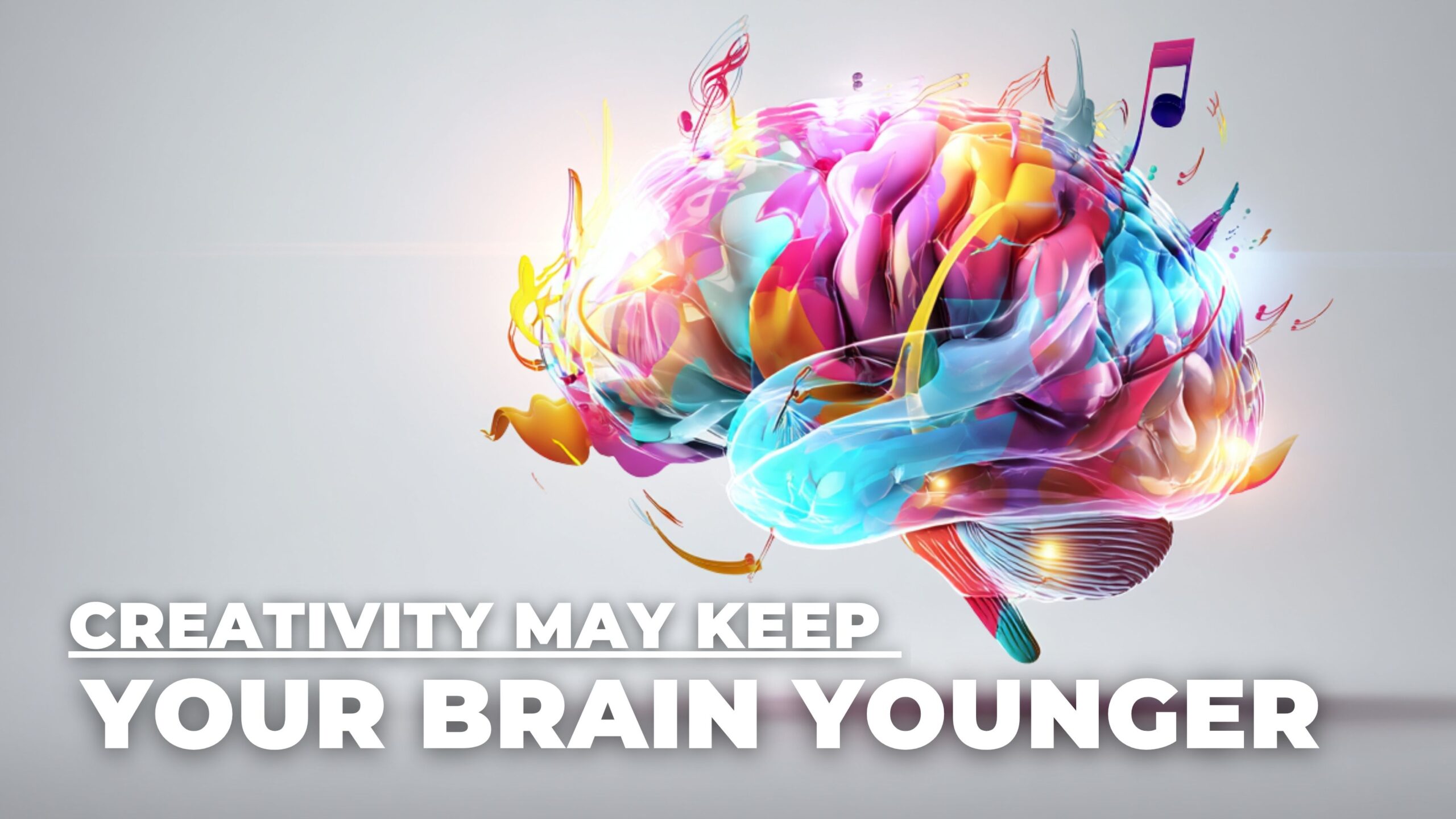
I don’t know about you but I want to keep my mind sharp as we age. Yet the brain naturally changes over time—shrinking in size, slowing in processing, and losing some flexibility to form new connections. But recent research suggests that how fast your brain ages isn’t set in stone.
A study published in Nature Communications found that people who engage deeply in creative pursuits—like dancing, playing music, painting, or even gaming—show brains that appear years younger than their age.
Researchers used machine learning and EEG data from over 1,200 participants to estimate each person’s “brain age gap” or BAG—a measure of how old or young the brain looks compared to one’s chronological age. Experts in creative fields had brains that were, on average, six years younger.
The results held true across all creative disciplines. Which means earning and mastering complex skills seemed to slow brain aging, likely by strengthening neural connections and improving communication between brain regions.
Even short-term learning mattered. Younger adults who trained intensively at a new video game reduced their brain age gap by more than three years. No change was seen in a control group, showing the benefit comes directly from learning although the longer the learning the better.
These effects weren’t limited to one area of the brain. Creative experts had stronger connections in networks that are critical for attention, motor control, coordination, and rhythm—regions that typically decline with age.
Although the researchers don’t go into detail on what drives the changes on a molecular level author and researcher Rhonda Patrick PHd suggests BDNF (brain-derived neurotrophic factor), a molecule that supports neuron growth and repair is a key player. BDNF tends to decrease as we get older, but it rises with physical activity, learning, and even heat exposure.
Here are three reliable ways to boost BDNF:
Taken together, these findings highlight an important point: creativity isn’t just for fun—it’s a form of brain maintenance.
Picking up an instrument, taking a dance class, learning to paint, or even playing strategy-based video games keeps your neural networks active. The key is consistency and challenge. The harder and longer you engage, the greater the brain benefit.
You don’t need to become a professional artist or musician to make an impact. What matters most is that you keep learning and practicing something that excites you.
Where possible try and shy away from always seeking mind numbing activities, and consuming media where the thinking and creativity is done for you (doom scrolling)…yes I’m thinking about my teenage children…and aim to push yourself a little every day.
Aging is inevitable—but how your brain ages is partly up to you.
Reference: Nature Communications, 2025 – “Creative expertise and brain age gap”

Over the last 10 years Ed has been building a YouTube library to help people manage their own pain or movement limitations and increase performance through exercise. He regularly adds videos so be sure to subscribe and visit regularly
"Oh My Gosh- I am ALREADY feeling relief after a few days! I used to wake up 2-3 times a night with shooting pain that anti inflammatories couldn't touch. Now I have been waking up just because I want to notice what it feels like to lay in bed pain free- THANK YOU!."

"When I first started with your program I was experience a lot of pain. Walking was difficult. I had to stop and catch my breath every few minutes and lean against a wall for support. Now when I walk with my husband we go for over an hour. I never had to sit down and stop...and, hardly any pain!!! 😊😊 I can’t thank you enough."
Frustrated that you aren't recovering fast enough?
Discover how to heal from illness and injury using movement, food and lifestyle.